

NEWCOMER GUIDE · ALBERTA
A move to Alberta often starts with a picture: a Calgary skyline, a walk through Edmonton’s river valley, perhaps the Rockies on a free weekend. The decision becomes more useful when you bring that picture down to street level. How will you get to work on a dark winter morning? What does the rent include? When will your health coverage actually begin? Those answers matter more to your first month than any promise of a fresh start.
Information checked: November 4, 2026. Use this guide to turn a big move into a series of manageable decisions. It is written for people arriving from abroad and from elsewhere in Canada, with the differences made explicit. It does not replace immigration permission or the official instructions for your circumstances.
Lead image: AI-generated editorial collage of Alberta landmarks, not a single real viewpoint.
Before booking the move, work out which rules belong to you
Two people can arrive in Alberta on the same day and need quite different plans. Someone transferring from Ontario may be arranging a handover between health plans. Someone arriving on a temporary permit must first check whether that document qualifies them for coverage at all. Start with your route into the province, not a generic newcomer checklist.
- Moving from another province or territory: plan the transition between health plans and, if you drive, your licence exchange.
- Arriving from outside Canada: keep your entry and status documents available for registration processes. Do not assume that every temporary permit qualifies for provincial healthcare.
- Moving with a work permit: read the permit before accepting work. Employer, occupation and location conditions can matter. A move does not remove them.
IRCC explains the conditions on employer-specific permits. Its separate guidance shows that even an open permit can carry location restrictions, including in some provincial nomination situations. Check the actual document rather than relying on the label “open”.
Prepare a secure folder with identity and immigration documents, employment references, education records, relevant family documents and copies of important prescriptions. Alberta’s newcomer overview is a useful starting point for organizing those records. Keep originals secure and share copies only when a legitimate service requires them.
Calgary, Edmonton or somewhere smaller? Start with an ordinary Tuesday
Imagine an ordinary Tuesday rather than your first holiday weekend. You need to reach work, buy groceries and perhaps collect a child before childcare closes. A place that looks ideal in photographs can become tiring when those journeys do not fit together. Build your shortlist around that day.
- Calgary: test candidate addresses in the Calgary Transit trip planner, using your likely start and finish times. A route that works at midday may be inconvenient for an early or late shift.
- Edmonton: use the city’s ETS trip planner to compare trips to work, school and appointments. Check transfers and the walk at both ends, not just the distance on a map.
- Other communities: investigate the municipality, local school division and actual transport options before signing a lease. Compare job access, housing availability and the cost of any vehicle you would need.
For each shortlisted home, write down the weekly commute, nearby shopping, school registration route and how you would reach an appointment without a car. Then ask a practical question: would this address still work if a shift changed, the car needed repairs or you had to make an extra school trip? A lower advertised rent is only the beginning of the comparison.
Read the lease as carefully as you view the kitchen
It is easy to fall for a bright kitchen and overlook the small print. Before transferring money, view the property where possible and check that the person offering it is entitled to rent it. Then ask what your payment buys: heat, electricity, water, parking, internet, appliances and any insurance requirement. Put the answers beside the advertised rent.
For tenancies covered by Alberta’s Residential Tenancies Act, the security deposit cannot exceed one month’s rent at the beginning of the tenancy. The province’s starting-a-tenancy guidance also explains fixed-term and periodic arrangements. Check which framework applies if your accommodation involves shared living space, a hotel or another special arrangement.
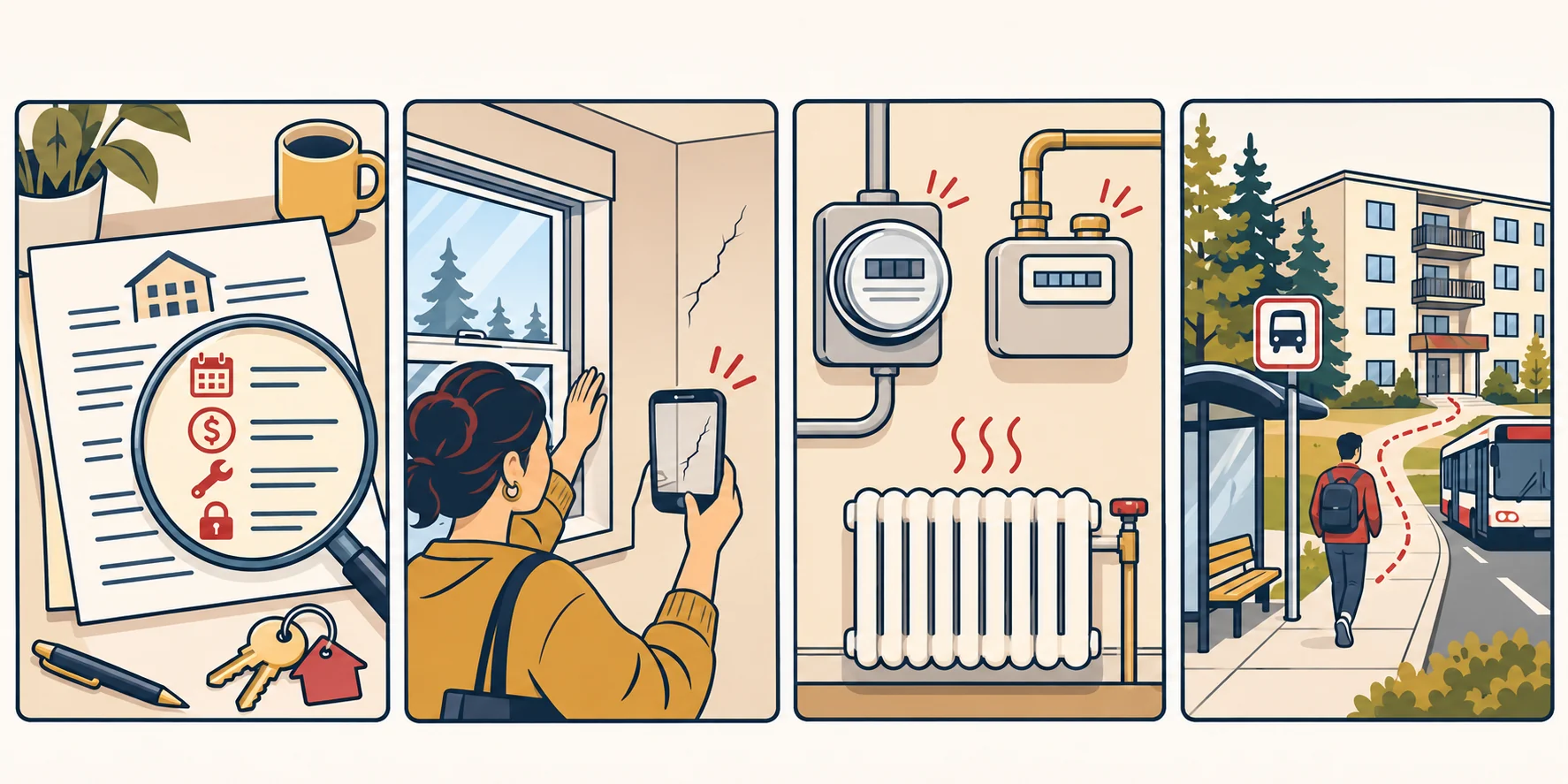
At a viewing, check four things: the written terms; the condition of the premises; which utility costs are yours; and the journeys you will make from that address. Photograph existing issues with permission, keep copies of documents and ask for receipts. Clarify the move-in inspection process with the landlord.
For privacy, do not treat your Social Insurance Number as a routine rental credential. Service Canada’s SIN Code of Practice explains that renting a property is not a purpose for which you are required to provide it.
Put healthcare on your calendar, not your assumptions
One of the most useful questions you can ask before moving is also one of the least glamorous: “Which health plan covers me on this particular date?” Do not leave the answer until you need an appointment. Alberta distinguishes where you are arriving from and whether you meet its residency and document rules.
| Your move | What Alberta says | What to do |
|---|---|---|
| From another Canadian province or territory | If you intend to live in Alberta for at least 12 months, apply within three months of establishing residency. Coverage normally starts on the first day of the third month after residency begins. | Ask your previous health plan about coverage during the transition and confirm your Alberta effective date. |
| From outside Canada | You may qualify from the date you establish residency, provided you meet the requirements and apply within three months. | Submit the required evidence; do not assume eligibility from arrival alone. |
| Temporary status | Document and residency requirements apply; not every permit qualifies. | Check the specific rules before relying on public coverage. |
These distinctions come from Alberta’s moving and health coverage instructions and its temporary-resident eligibility guidance. Special circumstances, including military families and family members arriving at different times, can change the result.
Registration is separate from finding a regular healthcare provider. Ask about access to local services and check what any employer or private insurance actually covers. Avoid assuming that a provincial health card pays every prescription, dental or other health-related expense.
Get your paperwork ready for the job you actually want
If you need a first Social Insurance Number, apply directly through Service Canada’s SIN application service. There is no application fee. If you already have a SIN, check whether your record needs updating rather than applying for an unrelated new number.
A SIN identifies you for employment and government programs; it does not replace the immigration permission you need to work. Check both your authorization and any professional licensing requirements before assuming you can start a particular job.
For orientation to the job-search process, use the provincial ALIS newcomer employment guide. Organize references, identify any credential-assessment steps and budget for a job search that may take longer than expected. Avoid building your moving budget around a job offer you have not received.
If you will drive and are making Alberta your permanent home, the province requires you to exchange your existing driver’s licence within 90 days. The exchange process depends on where the licence was issued and the class of licence; temporary residents and students have different rules. Check the current instructions before booking tests or surrendering documents.
For families, a home and a school are one decision
Contact the school authority serving your intended community. Ask which school can accept your child, what records are needed, whether language support is available and how transport works. Proximity does not by itself guarantee admission to a particular school.
The Calgary Board of Education’s documentation page lists evidence of address and a child’s identity, age and status among its requirements; extra records may be needed. Edmonton Public Schools says a family moving to Edmonton can register once it is living there, not before the move, and warns that capacity can affect placement. These are local examples, not identical instructions for every Alberta school division.
If you need childcare, contact providers about availability, hours and total charges. Keep childcare and school transport separate in your budget: a school place does not solve every before- or after-school care need.
Give your moving budget a reality check
A province-wide average cannot tell you whether your household can afford a particular move. Gather current listings and written quotes, then make two budgets: what it costs to arrive, and what it costs to stay each month. Keeping them separate stops a security deposit or a week of temporary accommodation from disappearing into an optimistic monthly total.
| Cost | What to record |
|---|---|
| Housing | Rent, deposit, parking, insurance and costs excluded from the lease |
| Utilities and connectivity | Heating, electricity, water where applicable, phone and internet |
| Transport | Transit fares or vehicle payments, insurance, fuel, parking and maintenance |
| Family and health | Childcare, school-related charges and health expenses not covered by your plans |
| Arrival costs | Travel, temporary accommodation, basic furnishings and registration expenses |
| Contingency | Money for delays, unexpected costs and a longer job search |
Alberta has no provincial sales tax, as confirmed by its Tax and Revenue Administration. That does not make every purchase tax-free or establish that your total household costs will be lower than elsewhere. Compare the full budget and use after-tax income when planning what you can afford.
Ask for settlement help early—and check the 2026 eligibility change
Use IRCC’s official newcomer service locator and ask a provider which programs you qualify for. Federal and provincial services have different eligibility rules.
From April 1, 2026, economic-class permanent residents generally have up to six years from becoming a permanent resident to access IRCC-funded newcomer services. IRCC’s eligibility notice says this changes to five years from April 1, 2027. The changes also affect qualifying family members on the same application. Other eligible categories follow different rules, and becoming a Canadian citizen ends eligibility for these federal newcomer services.
Do not conclude that every form of settlement assistance has ended if one federal program is unavailable. Alberta’s provincially funded settlement supports include specified groups such as naturalized citizens, eligible work-permit holders and refugee claimants. Ask a local provider to check the applicable program.
Once the urgent paperwork is moving, leave room to learn your neighbourhood. Visit the library, try the grocery journey and find a comfortable place to ask questions. Settling in is not a test you have to pass in a week; a workable routine is a better early goal than a perfect one.
Your first month: get the essentials working, then settle in

Tick each step as you work through it. These marks are temporary and reset when this page reloads.
Frequently asked questions
Is healthcare immediate when I move to Alberta?
Not for everyone. Moving from another Canadian province or territory usually involves a transition period; arrival from outside Canada has different rules. Confirm eligibility and the effective date with AHCIP.
Can I move before I have a job?
A job-search plan and permission to work are separate matters. Check your status conditions first, then decide whether your savings can cover housing and living costs without assumed employment income.
Should I choose Calgary or Edmonton?
Compare the addresses and services that fit your household. Test actual commutes, confirm school arrangements and price comparable housing before deciding. There is no single best choice for every newcomer.
How this guide was checked
This guide was checked against the linked Government of Alberta, Government of Canada, municipal transit and school-authority sources on November 4, 2026. Advice about comparing addresses and organizing a budget is editorial guidance, not a government requirement. For household costs, use fresh quotes for the place you are actually considering rather than treating an older province-wide average as your personal budget.
Eligibility and procedures can change. Check the responsible authority before acting. To report a material error, contact the editorial team through our Contact page and include the relevant statement and supporting source. Read our Editorial Policy for sourcing and correction standards.
Comments