

NEWCOMER GUIDE · NUNAVUT
A move to Nunavut starts with a practical question: what, exactly, is arranged when you arrive? A job offer, a flight booking and a place to live are separate pieces. Before committing money, make sure their dates, responsibilities and conditions fit together for the community you are moving to.
Information checked: November 4, 2026. This guide distinguishes official requirements from planning suggestions. Confirm personal eligibility and local arrangements with the responsible organization.
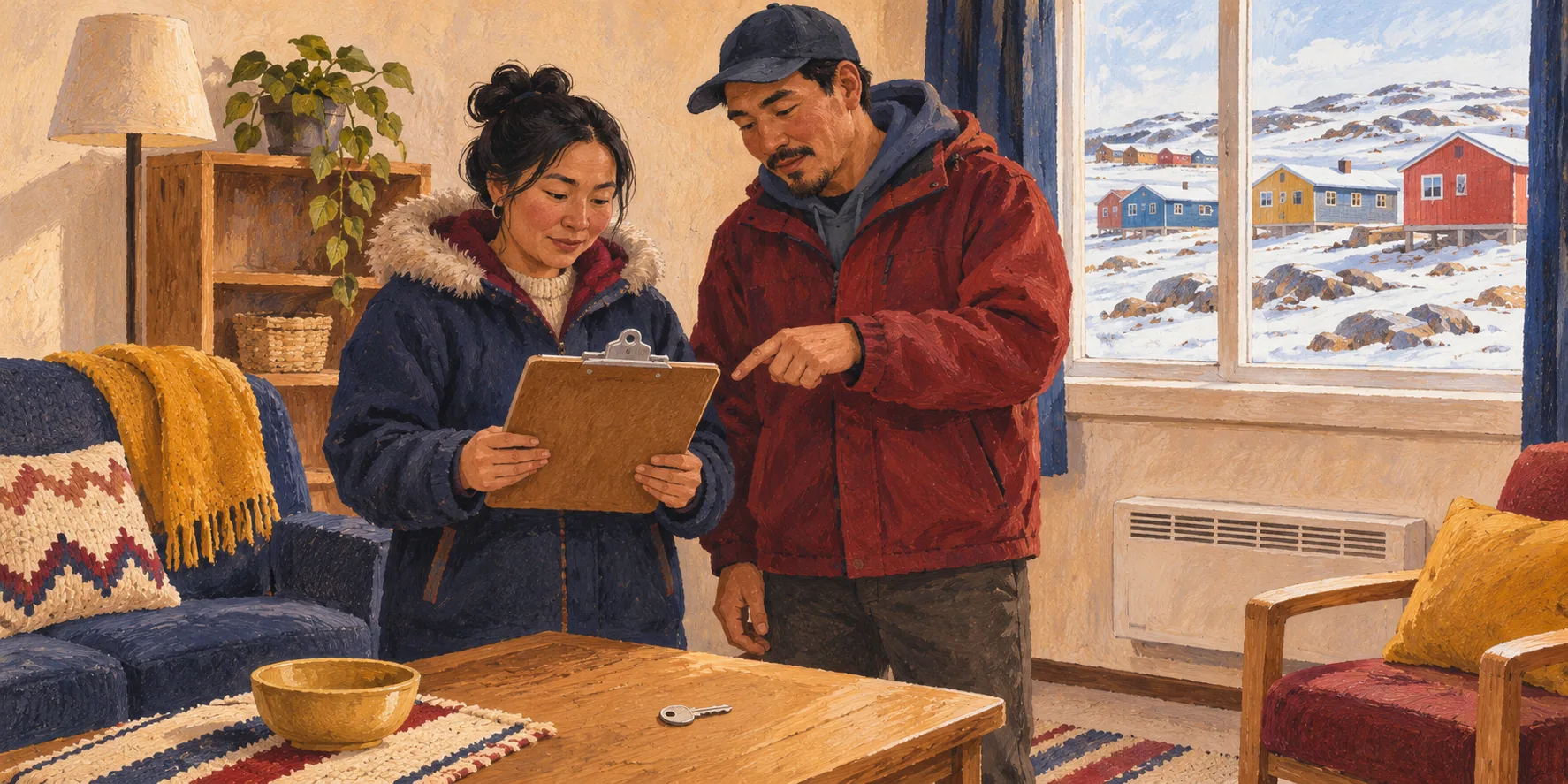
Lead image: AI-generated conceptual illustration, not a real location.
Find out which relocation arrangements apply to your position
The Government of Nunavut’s Human Resources relocation program serves government employees but explicitly excludes teachers, specialized healthcare positions, Qulliq Energy Corporation and Nunavut Arctic College staff from that particular program. An exclusion from this program does not establish what a different employer or employment arrangement provides: ask the team responsible for your position.
The government’s staff relocation guidance describes relocation assistance as an employment benefit and directs NEU employees or people entering NEU positions to the relocation provisions of their collective agreement.
Ask who authorizes each expense, who makes bookings, what receipts are required and what happens if the start date changes. Get housing arrangements in writing as well. Do not assume that an employment benefit advertised for one position is a general moving grant available to every newcomer.
Use the current health-card application for your circumstances
The territorial health-card questions and answers identify the new coverage application for people moving from another province or territory, arriving from outside Canada, or applying for the first time. Applying, replacing or updating a card has no fee.
Prepare clear copies of the supporting documents requested for your circumstances. The listed possibilities include your current health card, identity or immigration documents and proof of Nunavut residence. Forms are available through community health centres, Qikiqtani General Hospital in Iqaluit, the Rankin Inlet office and the government’s website.
Ask the Health Insurance Programs Office to confirm your eligibility and effective coverage date; its toll-free number is 1-800-661-0833. Coordinate the transition with your previous plan rather than assuming an application submission makes coverage immediate. Keep your mailing address current so correspondence and the card reach you.
Check residence and status before assuming health-plan eligibility
The new-resident application instructions ask for identity documentation and evidence that you intend to make Nunavut your main residence for more than 12 months, rather than being a temporary or rotational worker. The Health Insurance Programs Office determines eligibility.
The government’s plan overview also sets out conditions for employment- or student-visa holders and excludes visitors and certain temporary residents. If you are arriving on a permit, submit the details for an individual decision. The word “resident” in the territorial instructions should not be confused with Canadian permanent-resident immigration status.
Make a separate list of expenses beyond the basic plan. The overview identifies limitations for items such as prescription drugs and most dental services; other benefits depend on separate eligibility. Ask your employer or insurer what additional protection applies to your household, including any waiting period and exclusions. Keep the coverage decision and effective date with your moving documents.
Get a coverage date for the whole household
The application currently linked from the government’s health-card page says coverage may begin on the first day of the third month when eligibility requirements are met. It also describes additional considerations when spouses move on different dates. Use the official application and contact instructions to obtain a decision for your household rather than calculating an assumed date from the day you book a flight.
Ask the previous province or territory when its coverage ends, and confirm how any interval will be covered. Distinguish the date you become eligible from the date an application is processed or a card arrives. If those dates are unclear, resolve them with the Health Insurance Programs Office before relying on coverage.
Confirm which housing arrangement you are entering
Before booking the move, obtain a written answer about the accommodation: its address, possession date, cost, furnishings, included utilities and whether you will share it. If housing is connected to employment, ask what happens when the position or contract ends. Keep the housing terms alongside the employment offer rather than assuming they are identical.
The Nunavut Rental Office provides information on residential tenancy rights, repairs, security deposits and differences between staff housing, private rentals and public housing. It investigates and mediates complaints and can issue orders when disputes are not resolved. Its remit does not include federally owned housing.
Use the office to clarify a payment or tenancy term that is unclear before signing or transferring money. The published toll-free contact is 1-844-975-6314. Keep the agreement, receipts and a condition record from the start of occupancy. Ask who handles urgent repairs and how to report a problem when the usual contact is unavailable.
Read the deposit and rent-increase terms before signing
Section 14 of the official Residential Tenancies Act consolidation limits a security deposit to one week’s rent for a weekly tenancy or one month’s rent for other tenancies. For a non-weekly tenancy, half can be paid at the start and the other half within three months. Subsidized public housing and subsidized employer housing can use market-value rent to calculate the deposit.
Section 47 generally requires at least 12 months since the unit’s last rent increase, or first rent if previously unrented, and at least three months’ written notice. That section excludes subsidized public housing. Ask which arrangement applies and when the unit’s rent last changed; a new tenant should not assume their own move-in date restarts every timetable.
Plan the journey to the actual community
Nunavut is not a destination where a road itinerary between communities can be assumed. The federal territorial overview describes access to communities by air or sea, without roads connecting them to southern Canada. The current Travel Nunavut access guide also advises allowing for weather delays on connecting journeys. Build your arrival around the destination community, not simply the first airport on the itinerary.
Confirm every flight connection directly with the operating carrier, along with baggage rules, transport from the final airport and access to your accommodation. Keep a contact who knows your expected arrival and a plan for a delayed connection. Ask your employer which changes it handles if it is arranging the journey.
Treat household freight as a separate project. Obtain written delivery terms and ask which items can travel by your intended method, when they can arrive, and who receives them. Keep important documents, medication, warm clothing and first-night necessities with you. Do not make access to essential items depend on a shipment arriving on the same day as you.
Register through the school in your residential district
The government’s school calendar and registration page links the 2026–27 calendar, registration forms and a community school directory. It instructs parents to contact the school directly and register children in the district where they live.
The page says children who are five, or will turn five by December 31 of the year, can register. Children who will be six by December 31 and are not already attending must be registered. Check the receiving school’s instructions for your child’s circumstances and the current school year.
Before deciding on a start date, ask about records, placement, language support and any learning or accessibility needs. Arrange a secure way to send relevant school reports. Confirm the daily journey and childcare separately; a school registration does not establish a before- or after-school care place.
Arrange continuity of care before the flight
Use the Department of Health’s contact page and linked community-facility information to identify the service for your destination. Ask how to arrange routine appointments, what to do after hours and how prescriptions are handled. A territorial health card and an appointment are separate arrangements.
If you need regular treatment, discuss the move with your existing provider early. Prepare a medication list, relevant records and an appropriate supply arranged with your clinician or pharmacist. Ask the receiving service how records should be transferred securely, rather than sending medical information through a general website feedback form.
Check medical-travel arrangements separately from the health card
The government’s medical-travel guidance explains that support may be available when necessary care is unavailable in your home community. Eligibility includes being enrolled in or qualified for the Nunavut Health Care Plan, professional pre-approval, use of available other insurance and travel beginning in Nunavut.
Different programs and employer benefits can apply. Before making non-emergency travel arrangements, ask which program is responsible, what has been approved, who books the journey and which costs remain yours. An escort also needs approval based on support needs; a family member’s availability alone does not establish coverage.
Make a household backup plan for the practical consequences of an approved trip: time away from work, a child’s care arrangements and access to essentials if a return is delayed. Keep the regional travel-office contact with your booking documents. Do not assume a personally booked trip will be reimbursed because its purpose is medical.
Build a budget around the arrangements you have confirmed
Separate the cost of getting established from the cost of an ordinary month. Use written quotes and the terms of your actual home and employment offer. Keep an employer reimbursement separate from money already available: ask when it is paid and what evidence is needed.
| Budget line | Questions to resolve |
|---|---|
| Housing | Rent, payment dates, utilities, furnishings and conditions attached to employment. |
| Arrival | Flight connections, baggage, airport transfer, temporary accommodation and a delayed-arrival plan. |
| Freight | Shipping quote, delivery arrangements, permitted contents and storage if possession changes. |
| Routine | Groceries, phone and internet, local journeys, childcare and seasonal clothing. |
| Transition | Income before first pay, confirmed insurance gaps and any credential or licensing costs. |
For example, an offer with furnished housing may reduce what you need to ship, but only if the inventory meets your needs and the home is ready when you arrive. Check those details before paying to transport furniture or assuming every household item is supplied.

Put the dependencies in order
This on-page checklist is a planning aid. It is not submitted or stored as an application.
Questions to resolve before committing
Does a Nunavut job automatically include housing and relocation?
Check the written offer and the program for that position. Establish accommodation, travel and freight arrangements separately, including who pays, when reimbursement occurs and what conditions apply if employment plans change.
Can I drive between communities instead of booking a connection?
Do not plan around a highway connection. Confirm the transport options to your exact destination and the onward journey from the airport. Allow for changes to the itinerary and keep an accommodation contact available.
What should stay with me rather than in the freight shipment?
Keep essential documents, medication, warm clothing and the items needed for the first nights accessible. Confirm baggage conditions with the carrier, and arrange a backup if the main shipment arrives later.
Explore our Nunavut coverage for more regional information. If comparing destinations, see the Northwest Territories newcomer guide, while checking each territory’s administrative requirements separately.
Prepared by the KANADAS.top Editorial Team using the official and primary sources linked beside the information they support. Confirm personal eligibility, current arrangements and deadlines with the responsible organization before acting.
Comments